Before it falls
Dead & Hazard Tree Removal in Wilmington, NC
Taking down dead, decaying and leaning trees on a calm day instead of in the next storm.
- On-site quotes at no charge in Wilmington and nearby towns
- Prices put in writing before the crew arrives
- Cleanup terms written into the estimate
Trees That Are Already Failing
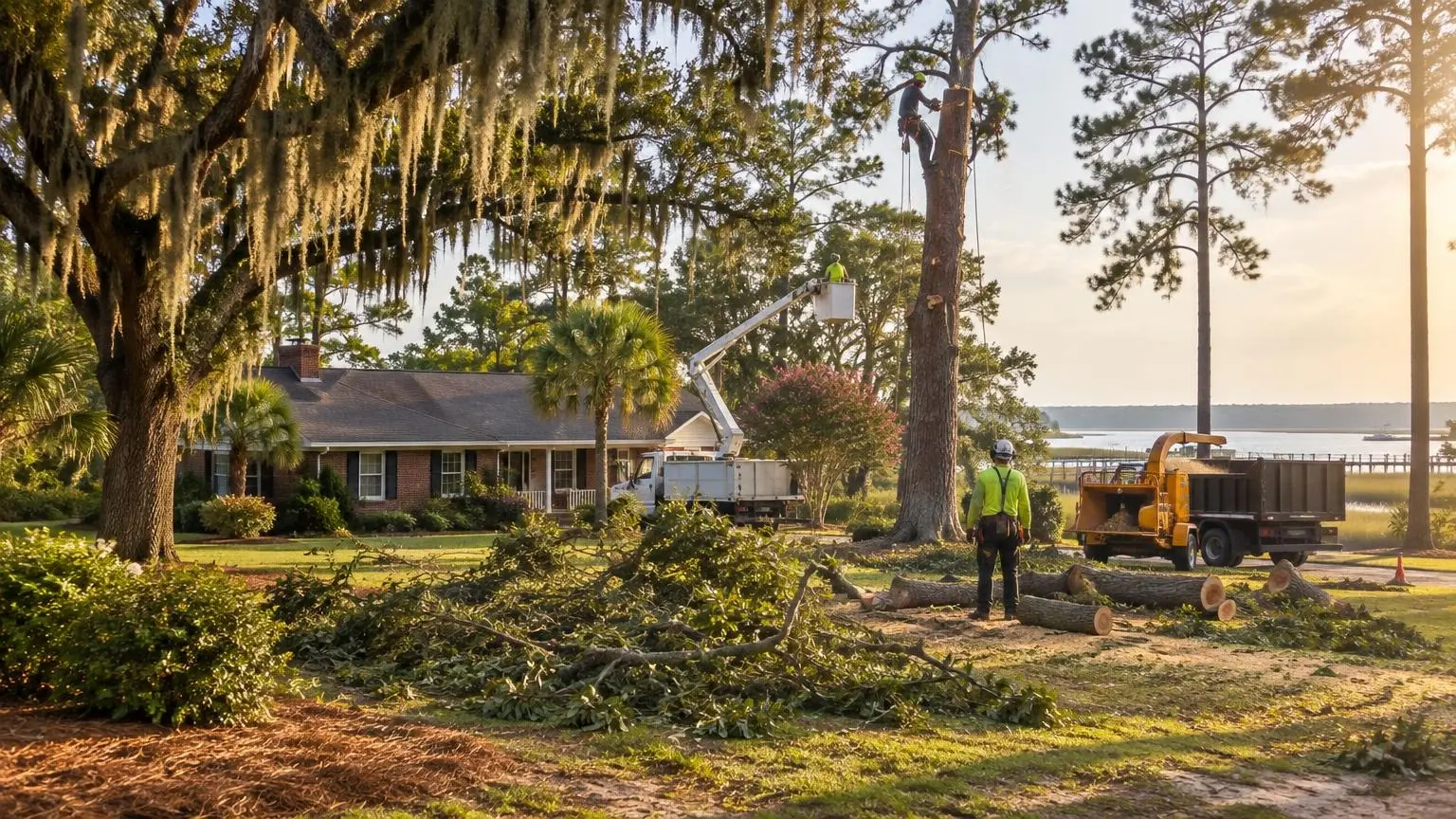
Dead and hazard tree removal is for trees that are already on their way down: pines that have died standing, oaks with rot hollowing out the trunk or main limbs, trees with cracks through a fork, and trees leaning harder than they used to. In Wilmington these tend to be the trees that fall during the next storm. Removing a hazard tree on a quiet day costs less and is far safer than dealing with it after it lands on a roof, and it lets the work be done carefully rather than in an emergency.
The laurel oak problem
Laurel oaks are one of the most common trees in Wilmington, about 14 percent of the trees counted in the city's urban forestry inventory, and many in older neighborhoods are large and getting old. They are fast-growing and weak-wooded, and they tend to decay from the inside. That's why their condition can be hard to judge from the ground. In July 2026, city arborists removed laurel oaks on South Live Oak Parkway that looked healthy but had severe decay in the limbs holding up the canopy and cavities up to two feet deep. Warning signs include fungus or mushrooms at the base or on the trunk, soft or crumbly wood in old wounds, hollow sounds when the trunk is tapped, and big dead limbs high in the crown.
Dead pines
A pine that has turned brown or red is dead, or nearly so. In coastal North Carolina, the usual causes are lightning, root damage from flooding or construction, storm breakage, and pine bark beetles, which NC State Extension says attack trees already weakened by drought, storms or fire. Southern pine beetles can spread to neighboring pines, and the Extension guidance for an active spot is to cut the infested trees promptly. Even without beetles, a dead pine dries out, gets brittle and starts dropping its top and limbs, which makes climbing it riskier. A tree that could have been climbed and cut in sections a few months ago may need a lift or crane later.
Leaning, cracked and root-damaged trees
A lean on its own isn't always a problem; many trees grow toward light and stay that way for decades. A lean that is new or getting worse is different, especially with soil cracking or lifting on the opposite side. Wilmington's sandy soil and high water table mean many trees root shallowly, and NC State Extension notes that high water tables, compacted soil and pavement all restrict root systems and make trees easier to blow over. Trenching for utilities, new driveways or pool installs within a tree's root zone can do the same damage, often showing up as dieback a few years later.
What This Covers
Hazard removals we quote most often around Wilmington.
Dead and beetle-killed pines
Red-topped and brown pines removed while the wood is still sound enough to climb and cut safely.
Decaying oaks
Laurel and water oaks with cavities, conks or soft wood, taken down in controlled sections.
Split and cracked trunks
Trees with a crack through a fork or a co-dominant stem pulling apart.
Leaning and root-damaged trees
Trees whose lean is new or worsening, or whose roots were cut by construction or flooding.
Lightning-struck trees
Trees with stripped bark or a spiral wound down the trunk, checked and removed if the damage is severe.
Dead & Hazard Tree Removal Price Ranges
| Job | Published range |
|---|---|
| Diseased tree with soft, breakable wood (Angi, national) | $400 to $900 |
| Pine removal (Lawn Love, national) | $475 to $1,450 |
| Oak removal (Lawn Love, national) | $380 to $1,160 |
| 40 ft tree, Wilmington (HomeBlue) | $450 to $860 |
| 60 ft tree, Wilmington (HomeBlue) | $680 to $1,290 |
Ranges from Angi (2026), Lawn Love (2026) and HomeBlue's Wilmington cost guide (2025). HomeGuide notes that dead trees often cost more to remove because brittle wood is harder to climb and rig. Your written estimate is the price.
What Happens on the Day
1. Look at the whole tree
We check the base, trunk, unions and crown for decay, cracks and dead wood, and note what the tree would hit if it failed.
2. Pick the safe method
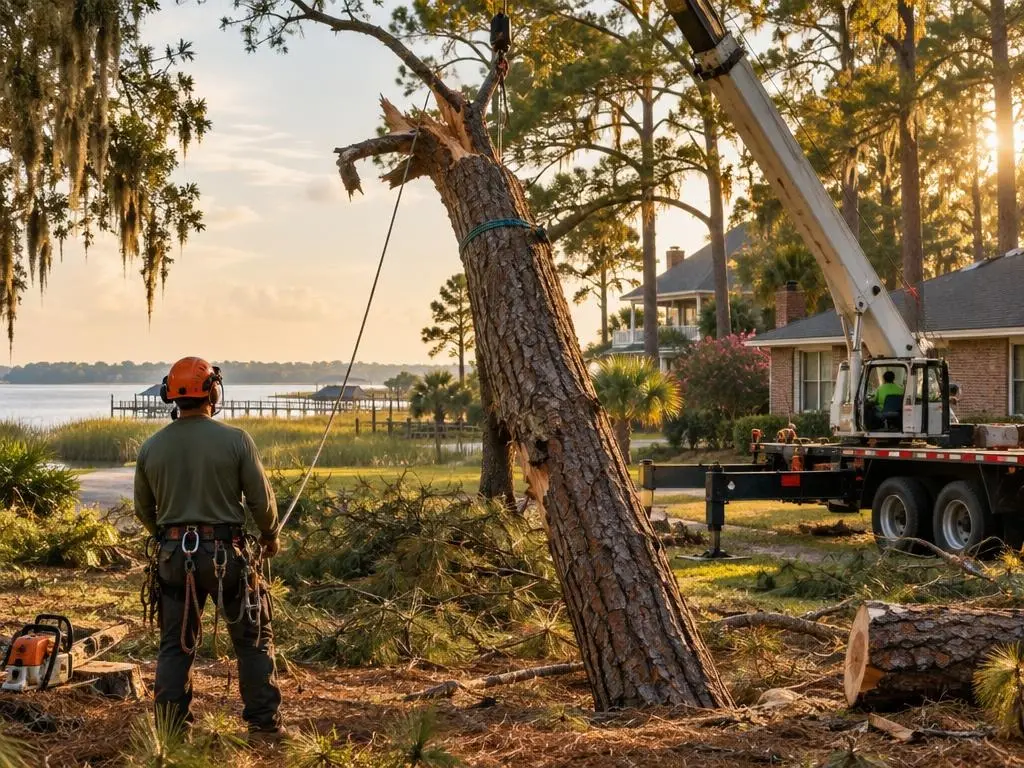
Sound trees are climbed; brittle or hollow ones may need a lift or crane so no one ties into weak wood.
3. Quote in writing
You get the method, cleanup, stump option and price for each tree.
4. Remove and clear
The tree comes down in controlled pieces, and beetle-infested pine wood is hauled off rather than left stacked near other pines.
Why Choose Us for Dead & Hazard Tree Removal
We explain what we see
You'll hear what made us call a tree a hazard, so the decision is yours and makes sense.
Method matched to the wood
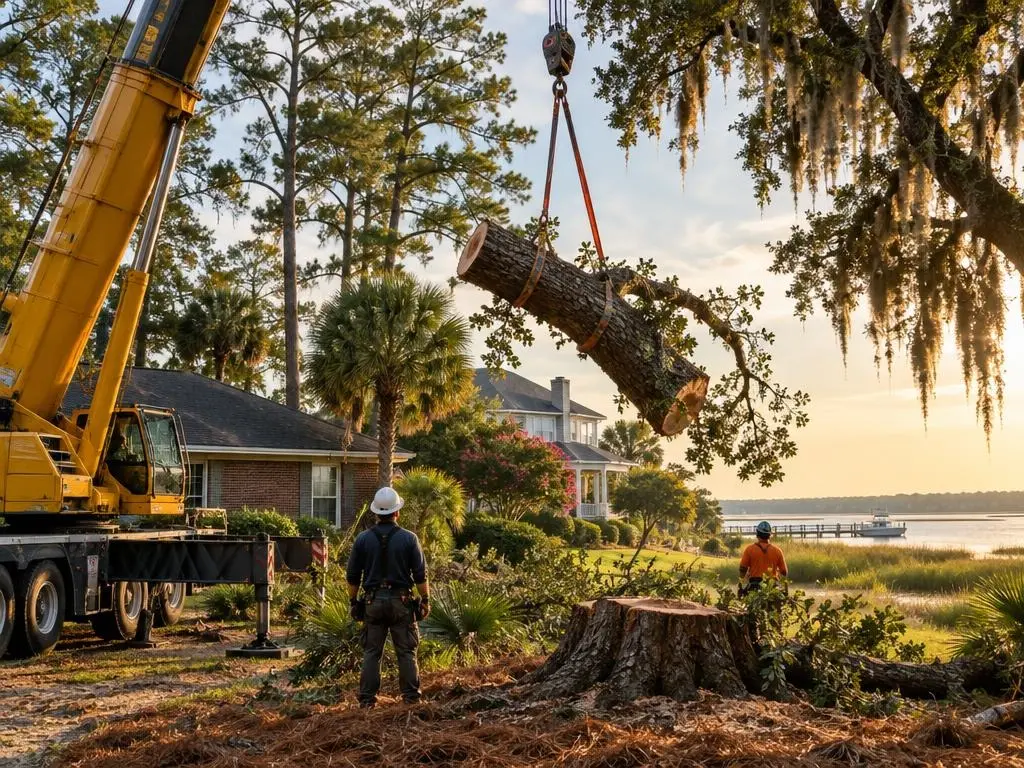
Dead and hollow trees get a different setup from healthy ones, chosen for crew and property safety.
Dead & Hazard Tree Removal Questions
Does a dead tree in Wilmington need a permit to remove?
The city's permit rules are based on where the tree is (right-of-way, historic district, large residential lots, buffers), not on whether it's alive. If your lot is in one of those categories, check with city zoning staff even for a dead tree. On a typical residential lot outside those categories, the city's permit list doesn't apply.
How can I tell if my oak is rotten inside?
Look for mushrooms or shelf fungi on the trunk or roots, cavities at old pruning cuts, cracks, and dead limbs high in the crown. Tapping a trunk with a mallet can reveal hollow areas. For a valuable tree, an arborist can use tools like a resistance drill to measure how much sound wood is left.
Will a dead pine spread beetles to my other trees?
It can. Southern pine beetles move to neighboring pines, and NC State Extension recommends cutting active infestations promptly. Ips and black turpentine beetles usually kill scattered trees rather than groups, but removing dead and dying pines still reduces the risk to the ones nearby.
Can a hazard tree be saved instead of removed?
Sometimes. Removing a dead limb, reducing a heavy one, or cabling a weak fork can make a tree safer for years. When decay has taken most of the trunk or main limbs, or the root plate is lifting, removal is usually the safer choice.
Dead & Hazard Tree Removal Service Areas
- Tree Removal in Wilmington, NC
- Tree Removal in Wrightsville Beach, NC
- Tree Removal in Carolina Beach, NC
- Tree Removal in Kure Beach, NC
- Tree Removal in Ogden, NC
- Tree Removal in Murraysville, NC
- Tree Removal in Myrtle Grove, NC
- Tree Removal in Kings Grant, NC
- Tree Removal in Skippers Corner, NC
- Tree Removal in Silver Lake, NC
- Tree Removal in Castle Hayne, NC
- Tree Removal in Porters Neck, NC
- Tree Removal in Bayshore, NC
- Tree Removal in Wrightsboro, NC
- Tree Removal in Sea Breeze, NC
- Tree Removal in Leland, NC
- Tree Removal in Belville, NC
- Tree Removal in Navassa, NC
- Tree Removal in Southport, NC
- Tree Removal in Boiling Spring Lakes, NC
- Tree Removal in St. James, NC
- Tree Removal in Hampstead, NC
- Tree Removal in Rocky Point, NC
- Tree Removal in Burgaw, NC
- Tree Removal in Surf City, NC
Get a Dead & Hazard Tree Removal Estimate
Worried about a dead or leaning tree? Send photos or call for a free look.