
Old farm country on the Northeast Cape Fear
Tree Removal in Castle Hayne, NC
Rural lots, fence-row oaks and pines on land that once grew bulbs and vegetables.
- On-site quotes at no charge in Wilmington and nearby towns
- Prices put in writing before the crew arrives
- Cleanup terms written into the estimate
Farmland History, Big Field Trees
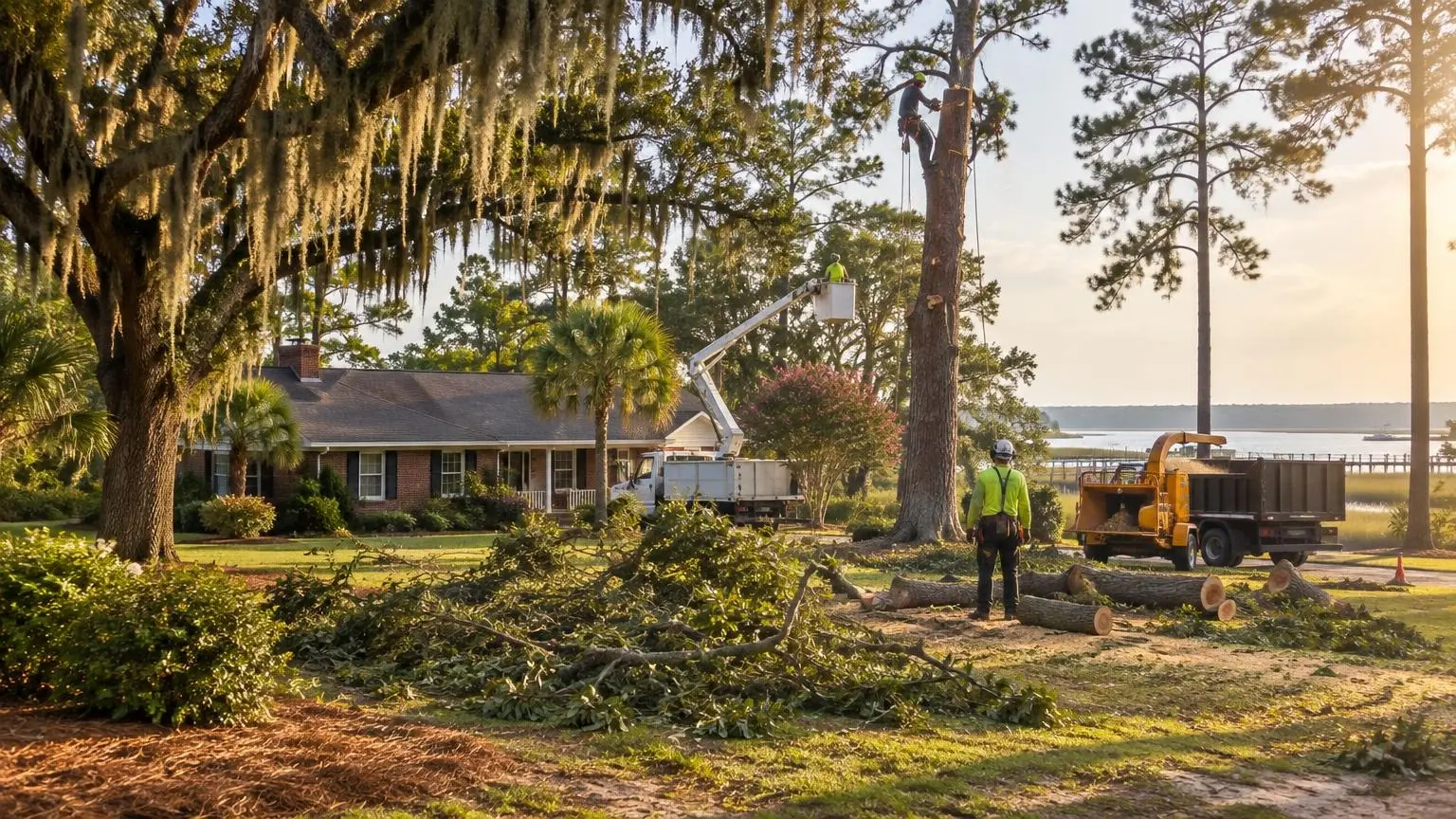
Tree Removal in Castle Hayne is often a rural job. The community sits about eight miles northwest of Wilmington on the northeast branch of the Cape Fear River, and much of it was farm country through the twentieth century. Around 1900 Hugh MacRae bought much of the old Burgwin property, and from 1905 his Carolina Trucking Company recruited farm families from the Netherlands, Poland, Hungary, Italy and Germany to settle the area. Trees here grew up along field edges, ditch banks and old house sites, and many of them are now very large.
Soil that grew everything
Castle Hayne's soil was described by those farm families as loamy, black and soft enough to grow almost anything. The Dutch Swart family moved here from the poorly drained Van Eeden colony for that soil, built a dairy and bulb business, and eventually owned close to 1,500 acres, with daffodils and gladiolus in bloom across the land. Horticulturist Eelco Tinga arrived in 1906, and Tinga Nursery grew out of his business. Rich ground grows big trees quickly, and fast-grown trees can carry weak wood and heavy limbs.
Trees on rural lots
Open ground changes how a removal works. Field-edge oaks and pines often stand alone, carry wide crowns and catch the full force of storms. During Hurricane Florence, the National Weather Service measured a 73 mph gust at Castle Hayne. A big lone tree that fails in a storm can take out a fence line, a barn roof or a well house. When there is room, we fell trees into open ground; when there isn't, we take them down in sections.
Jobs we see here
- Removing big oaks or pines near farmhouses, barns and sheds
- Clearing fallen trees from fence lines and field edges after storms
- Cutting back limbs over long gravel driveways so trucks and equipment can pass
- Taking out dead trees around old house sites
- Grinding stumps in pasture or yard so mowing is easier
Rules in an unincorporated area
Castle Hayne isn't a town; a 2011 vote to incorporate failed, so New Hanover County's rules apply. The county prohibits removing live oaks over 36 inches in diameter, except where a tree endangers public safety or disrupts public services. Separately, a 1987 state law that let New Hanover County and its towns regulate tree removal excludes agricultural, forestland and horticultural land. If your property is in farm or forest use, the rules may differ, so ask county planning.
Old homesites and hidden hazards
On land farmed for generations, trees sometimes hide things: old fence wire grown into the trunk, nails from long-gone signs, concrete footings or buried debris near an old house site. Metal in the wood is dangerous for saws and grinders, so we ask what you know about a tree's history and look for signs of embedded wire before cutting. If we find something, we adjust the cut or the stump grinding plan rather than forcing through it.
Request a visit
Call (910) 807-4337 or send the form with directions to the trees, especially if they are back from the road. Get a free estimate
Castle Hayne History and Conditions
- Immigrant farm colony. Hugh MacRae bought much of the former Burgwin property around 1900, and from 1905 his Carolina Trucking Company recruited farm families from the Netherlands, Poland, Hungary, Italy and Germany.
- Bulb farming. The Swart family's D. Swart Sons Bulb Company grew to close to 1,500 acres of daffodils and gladiolus before closing in 1973; Tinga Nursery dates to 1955.
- Florence wind. The National Weather Service recorded a 73 mph gust at Castle Hayne during Hurricane Florence in September 2018.
- Unincorporated. A 2011 referendum to incorporate Castle Hayne as a town failed, so county rules apply, including the ban on removing live oaks over 36 inches in diameter except for safety reasons.
Castle Hayne Questions
Can you reach trees at the back of a large property?
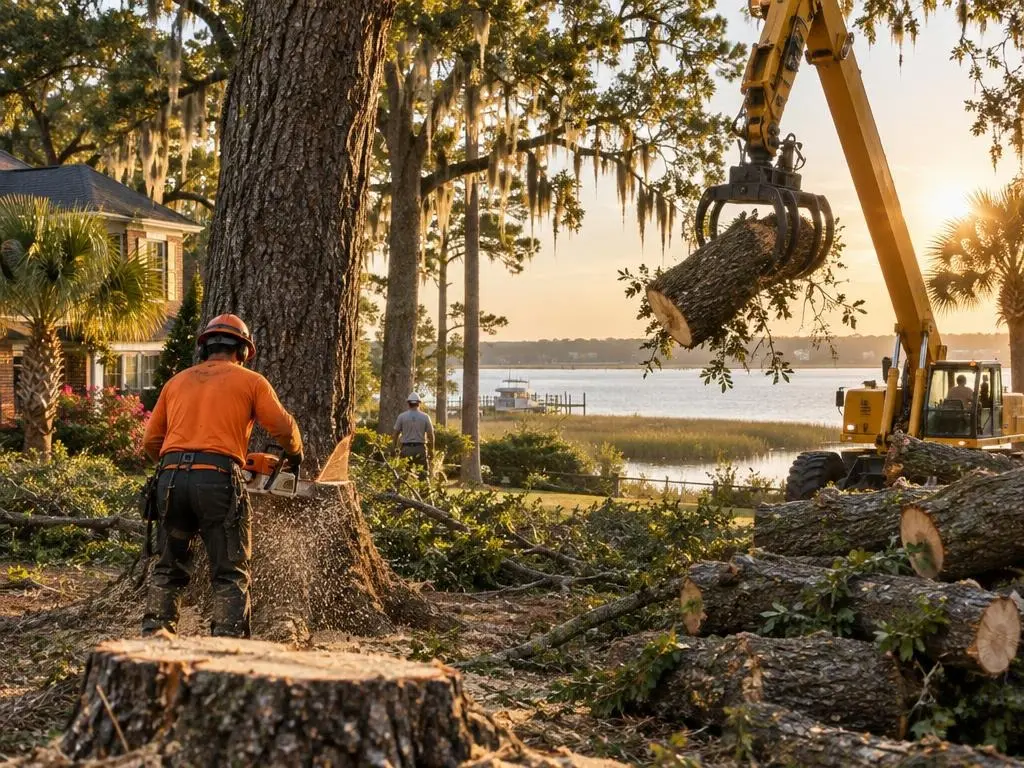
Usually, as long as there's a firm path for equipment. Let us know about soft ground, ditches or gates when you call, and we will plan the route so we don't rut your field.
What happens to the wood on a rural job?
You choose. We can chip and haul it, leave logs for you to split, or leave chips spread in a spot you pick. The estimate lists whichever option you want.
A big oak on my fence line belongs partly to my neighbor. What now?
Talk with your neighbor before any removal, since a boundary tree generally belongs to both owners. We can look at the tree and give you both the same written estimate.
There's old fence wire grown into my tree. Is that a problem?
It can be for saws and stump grinders, so tell us when you call. We work around embedded metal where we can, which may mean leaving a slightly taller stump or changing how we grind.
Free Estimates in Castle Hayne, NC
Estimates on farms, homesites and river lots around Castle Hayne.
Tree Removal Near Castle Hayne
- Tree Removal in Wilmington, NC
- Tree Removal in Wrightsville Beach, NC
- Tree Removal in Carolina Beach, NC
- Tree Removal in Kure Beach, NC
- Tree Removal in Ogden, NC
- Tree Removal in Murraysville, NC
- Tree Removal in Myrtle Grove, NC
- Tree Removal in Kings Grant, NC
- Tree Removal in Skippers Corner, NC
- Tree Removal in Silver Lake, NC
- Tree Removal in Porters Neck, NC
- Tree Removal in Bayshore, NC
- Tree Removal in Wrightsboro, NC
- Tree Removal in Sea Breeze, NC
- Tree Removal in Leland, NC
- Tree Removal in Belville, NC
- Tree Removal in Navassa, NC
- Tree Removal in Southport, NC
- Tree Removal in Boiling Spring Lakes, NC
- Tree Removal in St. James, NC
- Tree Removal in Hampstead, NC
- Tree Removal in Rocky Point, NC
- Tree Removal in Burgaw, NC
- Tree Removal in Surf City, NC